
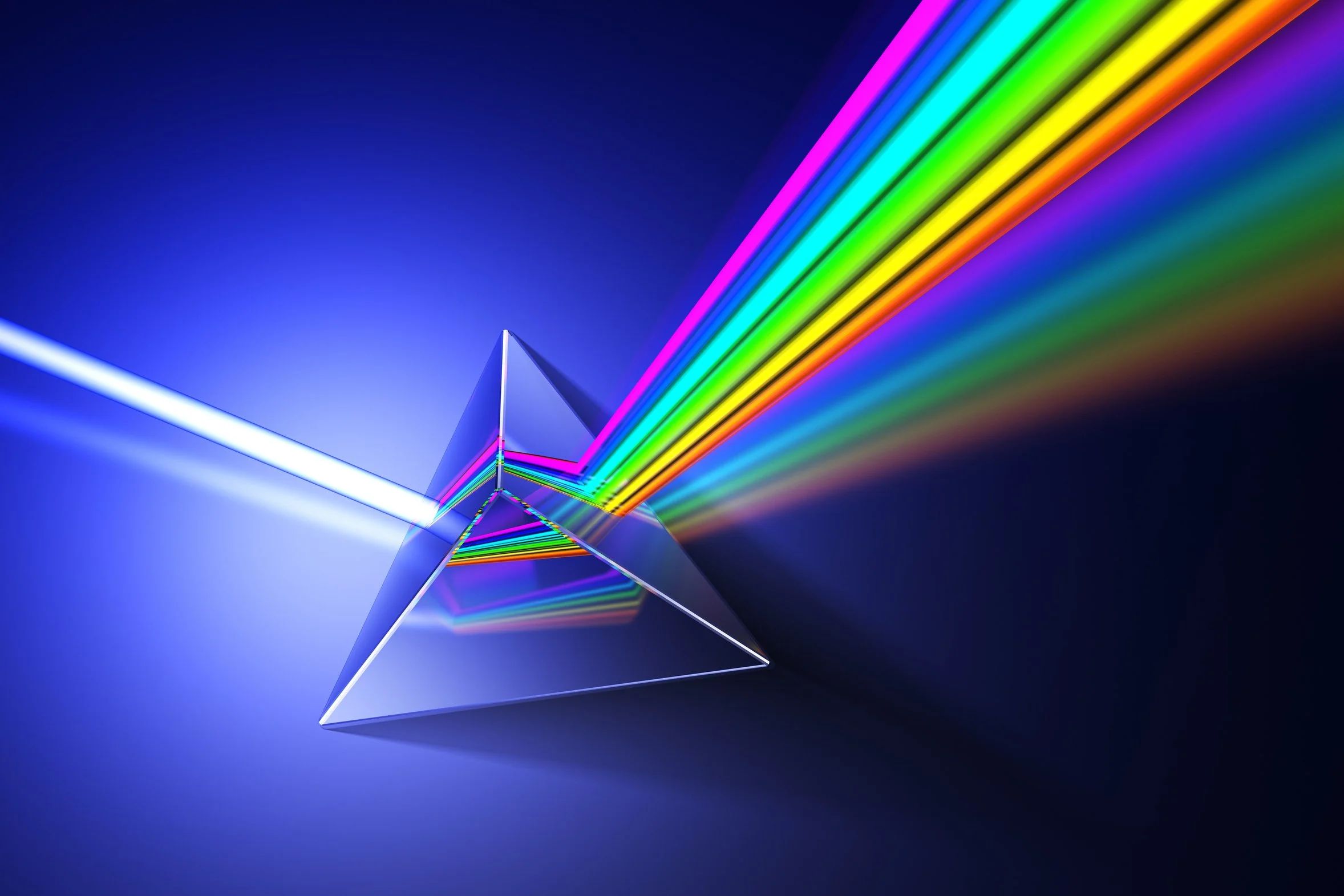
PrimerField Light Papers
The papers listed below present the PrimerField (PF) Theory framework as it applies specifically to light and photons. They develop a physically grounded description of photon structure, magnetic field geometry, and photon–photon and photon–boundary interactions using empirical constraints and experimentally validated optics. The papers are sequential and cumulative, with later results depending directly on definitions, field architecture, and physical mechanisms established earlier. For this reason, readers are strongly encouraged to review the papers in the order presented. Taken together, these works document the empirical basis and physical mechanisms underlying PF Theory’s treatment of photons, including wavelength formation, refraction, interference, and diffraction.
Transverse Sensitivity Scale of Photons
When light passes near an edge, that boundary alters where individual photons are detected—even when the edge is millimeters away. This paper directly quantifies that distance. Using experimentally validated Fresnel diffraction mathematics under fixed geometry, it shows that for visible light propagating 20 cm, boundary conditions continue to influence single-photon detection statistics over transverse distances of approximately 2 millimeters, corresponding to several thousand wavelengths.
This result is not a matter of interpretation or model preference. If boundaries millimeters away change where single photons are detected, then whatever physically carries that sensitivity cannot be confined to the scale of the wavelength. Any physically meaningful description of light must accommodate this real-space constraint.
Accordingly, this paper establishes a quantitative transverse scale that any theory of light—classical, quantum, or otherwise—must reproduce in order to remain consistent with standard diffraction experiments. Within PrimerField (PF) Theory, this scale is treated as a direct constraint on the transverse extent of the photon’s field structure. It provides the empirical numeric anchor used to estimate the size of the PrimerField surrounding an individual photon and is applied consistently throughout the PF literature.
PF Theory Paper II — Symbolic Reinterpretation
Building on Paper I's structural photon model, Paper II reinterprets the standard symbols ν, λ, and E within PF Theory — without introducing dynamics or mechanisms.
Frequency (ν) is reinterpreted as a configurational recurrence rate: how often photon spacings pass a fixed point in a coherent ray. It is not internal oscillation and not a detector count rate.
Wavelength (λ) corresponds to the PF-inferred configurational spacing d₀ between photons in coherent rays — a context-dependent observational mapping, not a universal definition.
Energy (E) correlates with field scale: higher-energy photons have smaller, more compact field structures. This is stated as correlation only; causation is deferred to Paper IV.
Wave-like spatial patterns arise from the periodic arrangement of discrete photon field structures — no individual photon oscillates.
All reinterpretations preserve empirical validity. Mechanisms, forces, and interference explanations are deferred to Papers III and IV.
PF Theory Paper V — Single-Photon Self-Interference and Diffraction
The apparent paradox of single-photon interference is resolved by recognizing that a photon is not a point particle but a particle-field system. Under the PF mapping assumption, a photon's field geometry extends transversely far beyond its wavelength — at reference geometry (λ=500 nm, z=20 cm), one-sided transverse sensitivity distance x*=2.0 mm (~4,000λ).
This extended field enables simultaneous geometric constraint by multiple boundaries. At a single edge, asymmetric constraint produces direction-shifted post-boundary trajectories. At a double slit, the field spans both slits while the photon core passes through only one — producing self-interference without superposition or wavefunction collapse.
The mechanism is configuration-constrained, not probabilistically deterministic. Apparent randomness arises from structural sensitivity to untracked microscopic variations, not intrinsic indeterminacy. No force acts on photons; no waves are required.
The interference pattern builds photon by photon through repeated geometric constraint events.
PF Light Series Meta-Paper: Series Overview and Synthesis
This meta-paper synthesizes the seven-paper PrimerField Light series without introducing new claims. The series proposes a single structural principle — photons possess dual bowl-shaped magnetic fields — and applies it geometrically across major optical phenomena:
Paper I: Photon structure
Paper II: λ as photon spacing; ν as detection rate
Paper III: Refraction and boundary deflection as field-geometry correspondences
Paper IV: Interference as polarity-alignment overlap
Paper V: Single-photon self-interference via extended field geometry
Paper VI: Beams as persistent photon field configurations
Paper VII: Polarization as static or patterned field axis orientation
The series imports no Maxwellian vectors, quantum formalism, or force laws. Its methodological claim is parsimony — one structural principle accounts for many phenomena. No predictive superiority over standard physics is claimed. Empirical adequacy remains to be established.
The Photon Is Not a Wave
This paper examines a foundational weakness in the standard model of light: while wave mathematics accurately predicts optical outcomes, it does not provide a physical mechanism for the behavior of individual photons. The paper argues that wave–particle duality is not a deep truth but a symptom of structural incompleteness. It introduces PrimerField (PF) Theory as an alternative framework in which photons are discrete, localized energy concentrations embedded within extended field structures. Within this framework, interference, diffraction, refraction, and double-slit behavior are reinterpreted as consequences of field-interaction geometry rather than intrinsic wave motion, collapse, or irreducible randomness. The paper is explicitly structural and qualitative, proposes clear experimental falsification conditions, and invites direct empirical testing rather than interpretive debate.
PF Theory Paper III — Field Interaction Mechanisms
Paper III introduces PF Theory's first structural process interpretation: how overlapping photon field structures produce brightness and darkness.
The mechanism is geometric compatibility. When like-polarity field regions overlap (N-N or S-S), the composite structure is geometrically compatible, corresponding to enhanced detector response — brightness. When opposite-polarity regions overlap (N-S), the composite structure is geometrically incompatible, corresponding to reduced detector response — darkness.
This resolves the classical puzzle of destructive interference without wave subtraction, vector cancellation, or energy disappearance. Photons remain discrete throughout — count, energy, and structure are all conserved. Only the composite geometric configuration presented to the detector changes.
Bright fringes correspond to compatible overlap regions; dark fringes to incompatible regions. The alternating pattern of interference corresponds to spatial alternation between these two configurations.
No Maxwellian field equations or energy-density formalism is employed. Single-photon self-interference and diffraction mechanisms are deferred to Paper V.
PF Theory Paper VI — Multi-Photon Configurations and Beam Structure
Paper VI extends the single-photon model to multi-photon systems, describing how discrete photons configure into coherent beams geometrically.
In coherent beams, photons arrange axially with each photon's south bowl facing the next photon's north bowl — opposite-polarity nesting at wavelength-scale spacing. This repeating N-S-N-S pattern is the structural origin of what standard physics models as a wave. Wave-particle duality dissolves: photons are particles with wave-like spacing.
Transverse field overlap (~4,000λ one-sided) links parallel photon chains into correlated three-dimensional beam structure. Coherence is reinterpreted as configurational regularity — temporal coherence as consistent axial spacing, spatial coherence as transverse alignment.
Wavelength reduction in materials corresponds geometrically to modified photon spacing; restoration upon exit follows automatically from field geometry.
No force laws, energy exchange, or stability mechanisms are claimed. All dynamical explanations are explicitly deferred to future work.
Entanglement Is Not Real: A PrimerField Account of Correlated Photon Pairs
Quantum entanglement, as popularly described, does not exist. What exists is correlation — two photons created together in a structured field environment (a nonlinear BBO crystal) that imposed matching geometric properties on both at the moment of creation. Each photon then propagates independently, carrying its properties locally.
The PrimerField framework treats photons as extended dual-bowl field structures with definite geometric properties from creation. Polarization is orientation — set by the crystal's asymmetric internal field geometry, not indeterminate until measured. Measurement reveals what was already there.
Bell's theorem rules out local realism for point-particle ontologies. Whether it applies to extended-field-structure ontology remains an open calculation. The decisive unsolved problem: deriving the cos²θ Bell-correlation function from PF photon geometry.
The correlations are real. The non-locality is not. It is an interpretive artifact of insisting particles are points when they are not.
PF Theory Paper I — Photon Ontology
Standard physics describes the photon mathematically but provides no physical model of what it actually is. Wave-particle duality names the problem without solving it; quantum mechanics retreats to instrumentalism rather than explanation.
PrimerField Theory proposes a structural alternative: the photon is a localized energy concentration embedded within two opposing bowl-shaped field regions of complementary geometric orientation. Energy is confined by geometry, not oscillation. No internal periodic motion exists.
In coherent rays, photons arrange at a characteristic spacing d₀ that corresponds to the experimentally measured wavelength λ. Wave-like experimental signatures arise from the spatial extent and periodic arrangement of photon field structures — not from probability waves or measurement collapse.
Linear polarization is an intrinsic geometric property of the photon's field axis, not a superposition state.
Papers II–VII will test this ontology against interference, diffraction, refraction, and the double-slit experiment.
PF Theory Paper IV — Interference Phenomena as Field Overlap Configurations
Paper IV applies the correspondence framework from Paper III to multi-photon interference phenomena, mapping geometric overlap configurations to observed detector patterns.
PF "phase" is redefined as geometric alignment between photon field structures — not oscillation position. "In phase" means same-polarity regions overlap (N-N, S-S); "out of phase" means opposite-polarity regions overlap (N-S).
Same-polarity overlap produces compatible configurations corresponding to enhanced detector response — bright fringes. Opposite-polarity overlap produces incompatible configurations corresponding to reduced detector response — dark fringes. The alternating bright-dark interference pattern is the spatial consequence of alternating compatible and incompatible overlap regions.
Critically, PF interference invokes no wave superposition, no path-length phase accumulation, no probability amplitudes, and no vector field mathematics. It is purely a geometric overlap description applied to discrete photon field structures.
Single-photon self-interference and diffraction mechanisms are deferred to Paper V.
Paper VII: Polarization as Static Geometric Configuration
Paper VII completes the seven-paper PrimerField Science Paper series by reinterpreting polarization geometrically rather than as oscillating electromagnetic vectors.
Key claims:
Linear polarization — all photons in a beam share the same fixed N-S field axis orientation.
Circular polarization — sequential photons have progressively offset static N-S axes, forming a helical spatial pattern across the beam. No individual photon rotates or spins.
Elliptical polarization — a beam-level configurational asymmetry in projected field orientation across two perpendicular axes.
Polarizer interaction — described interpretively as orientation filtering based on geometric compatibility between photon field axis and polarizer transmission axis. Malus's law correspondence is noted but not derived.
Birefringence — orientation-dependent material correspondence; atomic mechanism unspecified.
No new PF structures are introduced. All polarization states are static geometric properties — of individual photons (linear) or photon ensembles (circular/elliptical).